King's Indian Defense diagram
The King's Indian Defense (E70) arises after 1. d4 Nf6 2. c4 g6 3. Nc3 Bg7 4. e4 d6. Black allows White a broad pawn center, then strikes back with ...e5 or ...c5 and often a kingside pawn storm.
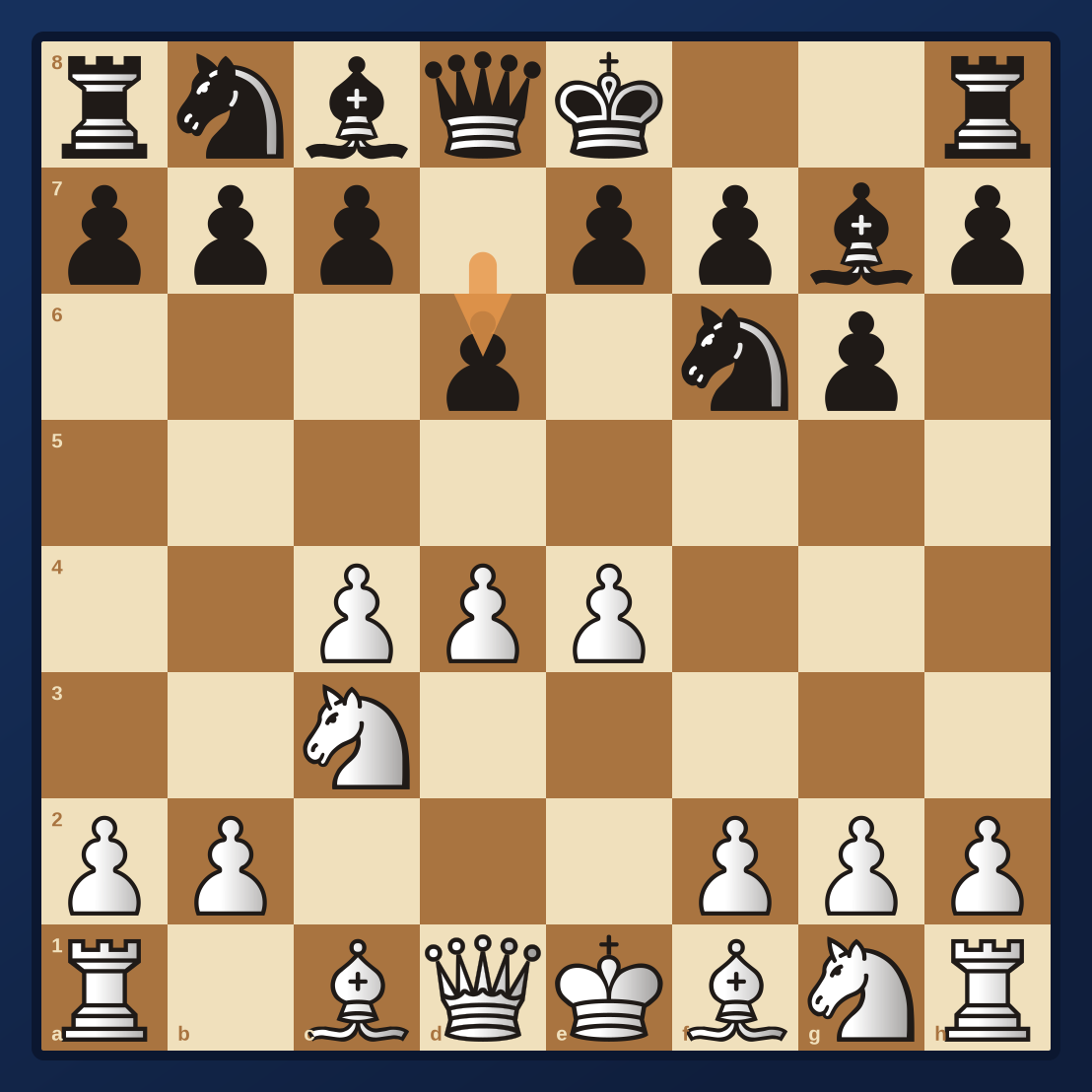


Position facts
| ECO code | E70 |
|---|---|
| Moves | 1. d4 Nf6 2. c4 g6 3. Nc3 Bg7 4. e4 d6 |
| FEN | rnbqk2r/ppp1ppbp/3p1np1/8/2PPP3/2N5/PP3PPP/R1BQKBNR w KQkq - 0 5 |
| Side to move | White |
| Group | Indian defenses (1.d4 Nf6) |
Key ideas
- In many main lines, White attacks on the queenside and Black on the kingside.
- The g7 bishop is often Black's most important piece.
- It is famous for sharp, double-edged middlegames.
Embed this diagram
Paste one of these into a blog, forum, Notion page or README. The image is served by the free ChessVG board image API, so you can change the theme, pieces or arrows by editing the URL.
Related openings
- Nimzo-Indian Defense (E20)
- Grünfeld Defense (D80)
- Catalan Opening (E00)
- Dutch Defense (A80)
- Queen's Indian Defense (E12)
- Benko Gambit (A57)
- Budapest Gambit (A51)