Sicilian Dragon diagram
The Sicilian Dragon (B70) arises after 1. e4 c5 2. Nf3 d6 3. d4 cxd4 4. Nxd4 Nf6 5. Nc3 g6. Black fianchettoes the dark-squared bishop on g7, where it bears down the long diagonal. The name is usually traced to the pawn structure's resemblance to the constellation Draco.
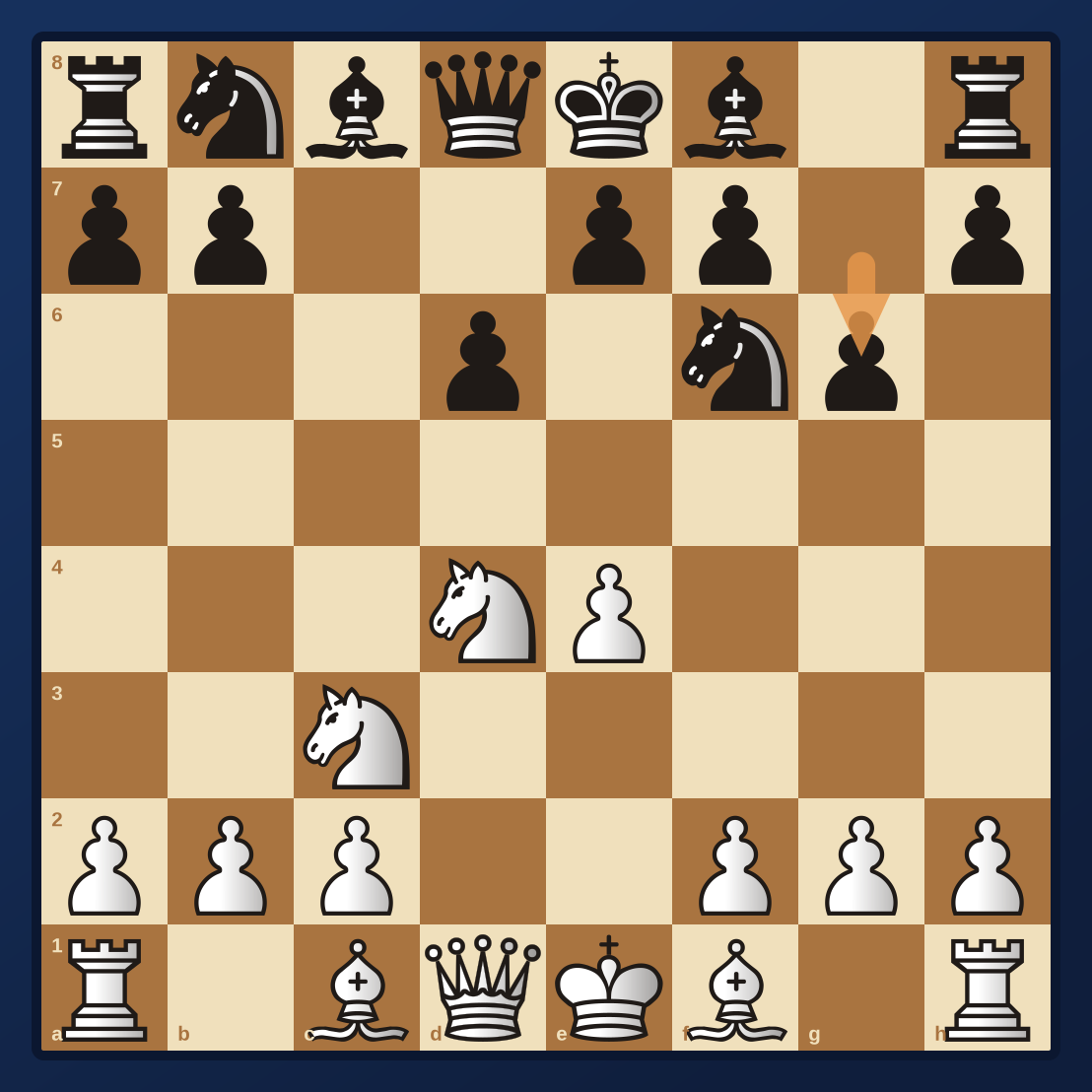


Position facts
| ECO code | B70 |
|---|---|
| Moves | 1. e4 c5 2. Nf3 d6 3. d4 cxd4 4. Nxd4 Nf6 5. Nc3 g6 |
| FEN | rnbqkb1r/pp2pp1p/3p1np1/8/3NP3/2N5/PPP2PPP/R1BQKB1R w KQkq - 0 6 |
| Side to move | White |
| Group | Semi-open games (1.e4, other replies) |
Key ideas
- The Yugoslav Attack (Be3, f3, Qd2 and long castling) is White's sharpest answer.
- Black's counterplay often runs along the half-open c-file, with an exchange sacrifice on c3.
- Games are often decided by a direct race between the two kings.
Embed this diagram
Paste one of these into a blog, forum, Notion page or README. The image is served by the free ChessVG board image API, so you can change the theme, pieces or arrows by editing the URL.
Related openings
- Sicilian Defense (B20)
- Sicilian Najdorf (B90)
- French Defense (C00)
- Caro-Kann Defense (B10)
- Scandinavian Defense (B01)
- Pirc Defense (B07)
- Alekhine's Defense (B02)
- Sicilian Accelerated Dragon (B34)
- Sicilian Sveshnikov (B33)
- Alapin Sicilian (B22)
- Smith-Morra Gambit (B21)
- French Defense: Advance Variation (C02)
- French Defense: Winawer Variation (C15)